
In today’s environment, a single cyber breach can cost millions, erode customer trust, and expose your entire organisation to regulatory action. For board executives, understanding cybersecurity is not optional - it’s a critical part of your fiduciary duty. With an average global cost of $4.88 million USD per data breach (IBM Cost of a Data Breach Report), minimising this risk is both a governance obligation and a strategic imperative.
The Board-Level Imperative
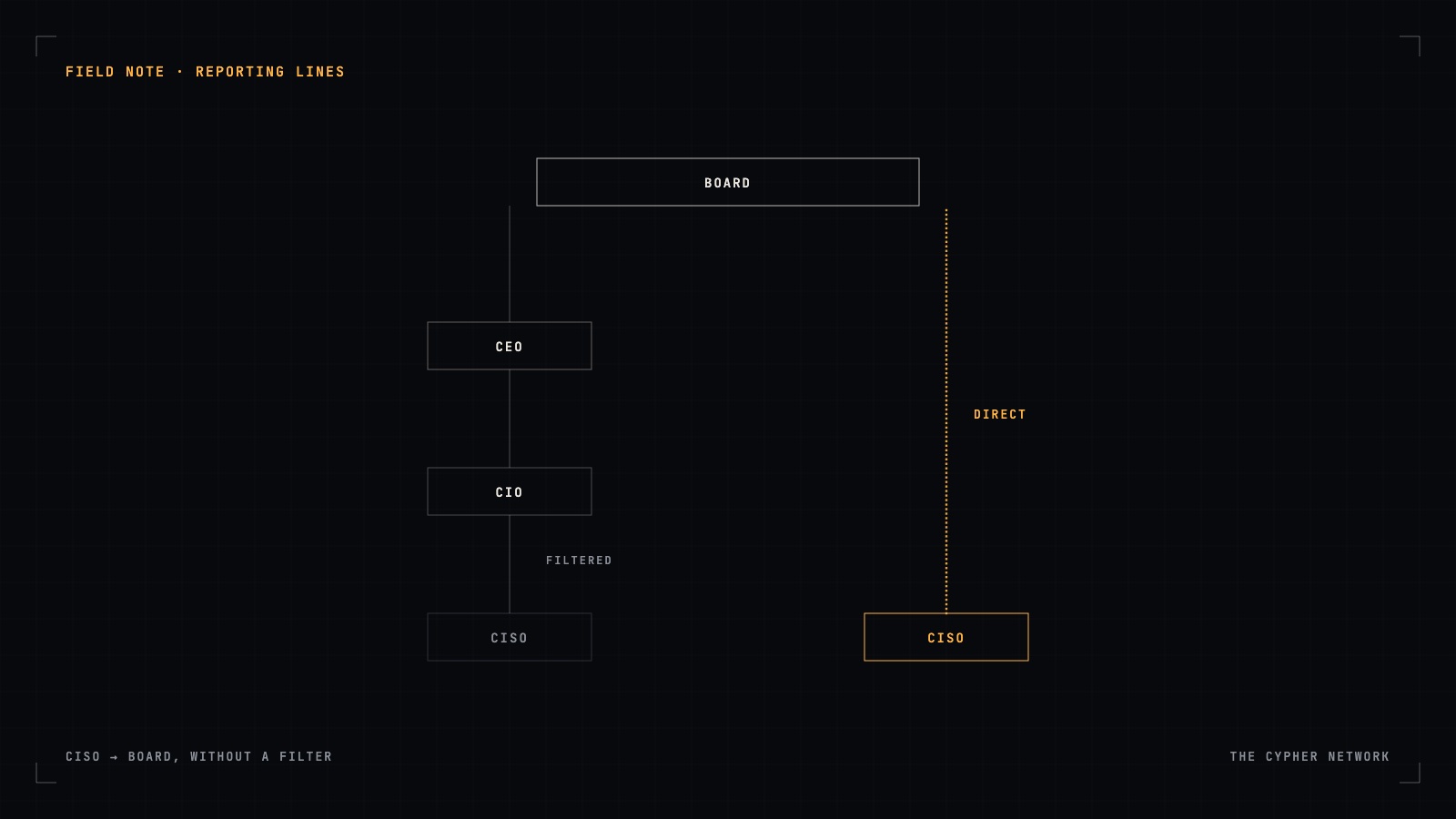
Cybersecurity cannot be relegated to the CIO or CTO, it must be a core business priority. When the CISO reports to IT leadership, security is often filtered through operational goals - potentially downplaying serious threats. Instead, having the CISO report directly to the board ensures urgent issues receive immediate attention at the highest level, maintaining clear visibility into emerging cyber risks.
Why It Matters for Your Organisation
- Direct Line of Sight on Risk: Board members need unfiltered insights to fully grasp cyber threats. This is especially crucial in fast-evolving environments where advanced threats or business changes (like M&A or digital transformation) can rapidly escalate risk.
- Proactive Oversight: A CISO with direct board access drives continuous monitoring rather than point-in-time audits. This proactive stance is vital in a landscape where threats evolve daily, not annually.
- Cultural Influence: Reporting structures shape culture. Positioning cybersecurity as a board priority signals to all employees that it’s everyone’s responsibility, reinforcing a security-first mindset.
- Protection During M&A and Digital Transformation: Integrating security from the outset of any deal or product launch protects against inherited vulnerabilities or rushed digital rollouts. Failing to embed security can lead to costly breaches that undermine strategic initiatives.
- DevSecOps and Beyond: Embedding security into development and operations (DevSecOps) prevents vulnerabilities before they occur. A CISO operating at board level can champion security in all digital initiatives, aligning development speed with robust risk mitigation.
- Business Risk Alignment: At the board level, the CISO isn’t just safeguarding data - they are a key partner in identifying, quantifying, and mitigating broader business risks. By aligning cybersecurity with overarching strategic goals, the board can see cybersecurity decisions not as costs, but as critical investments in the organisation’s resilience.
- AI & Emerging Threats: Attackers increasingly leverage artificial intelligence to automate complex campaigns, making it easier to bypass traditional defenses. A CISO who stays current on AI-driven threats can adapt your security posture accordingly, safeguarding your organisation as the threat landscape evolves.
Real-World Examples of CISO Oversight Gaps
Below are instances where CISOs lacked direct board reporting, contributing to slower detection, less transparency, or delayed response:
- Target (2013): At the time, Target’s security team ultimately reported through its IT hierarchy. Early warnings of suspicious network activity went unheeded, resulting in a breach of 40 million credit card numbers. While widely reported that Target faced over $162 million in breach-related costs in 2013–2014, the multi-state settlement fine itself was $18.5 million.
- Equifax (2017): The Equifax CISO did not have a direct line to the board, which meant critical risks were not escalated effectively. A known vulnerability remained unpatched, exposing 147 million records and leading to more than $1.4 billion in settlements.
- Uber (2016): Uber’s security function was overshadowed by operational pressures, without a dedicated channel to the board for incident reporting. Consequently, a breach affecting 57 million users was concealed, illustrating how a lack of board-level transparency can amplify reputational and legal fallout.
- Marriott/Starwood Merger (2016-2018): Marriott’s CISO was not fully positioned at the board level to oversee cybersecurity aspects of the Starwood acquisition. A significant inherited breach involving up to 500 million guest records went unnoticed until after the merger, highlighting the need for strategic security oversight in M&A.
In several organisations, when the CISO reports into the CTO or CIO, the drive for operational efficiency can filter and dilute critical cyber risk insights. Industry surveys, such as those by PwC, indicate that only about 40% of CISOs report directly to the board. This structure often delays or mutes the escalation of threats, leaving the board under-informed and less agile when responding to emerging risks.
These examples underscore a universal truth: when cybersecurity is treated as an afterthought or managed within operational silos, boards - and by extension, organisations - are left vulnerable in times of crisis. These cases illustrate the high cost of failing to maintain clear, board-level oversight of cybersecurity efforts.
The Regulatory Landscape in Australia: Why Local Expertise Matters
For international companies operating in Australia, understanding and complying with local regulations is paramount. Key frameworks include:
- Privacy Act 1988 (amended by the Privacy Legislation Amendment (Enforcement and Other Measures) Act 2022): Governs how personal information must be handled, including the collection, use, storage, and disclosure of personal data. Notably, the 2022 amendments significantly increase penalties for serious or repeated breaches, up to the greater of $50 million AUD, three times the benefit gained, or 30% of adjusted turnover.
- OAIC – Notifiable Data Breaches (NDB) Scheme: Enforced under the Privacy Act, this requires prompt reporting of data breaches to protect consumer privacy.
- APRA CPS 234: Mandates robust cybersecurity controls for financial institutions to ensure the resilience of the financial system. https://www.apra.gov.au/information-security
- ACSC Essential Eight: A set of baseline mitigation strategies advocated by the Australian Cyber Security Centre to help organisations protect themselves against cyber threats.
- Security of Critical Infrastructure Act 2018 (SOCI): Imposes obligations on owners and operators of critical infrastructure to manage and report cybersecurity risks.
- Telecommunications and Other Legislation Amendment (Assistance and Access) Act 2018 (TOLA): Provides Australian law enforcement and security agencies with legal means to request assistance from communication providers.
- ACSC Guidance: The Australian Cyber Security Centre provides essential advice and support for managing cyber risks in the local context.
These frameworks add layers of accountability and due diligence that international companies must adhere to. Without local expertise, organisations risk non-compliance, significant fines, and reputational harm.
Why an Australian Fractional CISO?
For organisations operating in or entering the Australian market, local expertise is paramount. From strict privacy laws to sector-specific regulations, boards must be confident in their compliance. An Australian Fractional CISO offers:
- Targeted Knowledge: Deep understanding of local regulations and market nuances.
- Board-Level Accountability: Ensures cybersecurity remains top-of-mind at every board meeting.
- Cost-Effectiveness: Access to specialised, senior-level expertise without the overhead of a full-time executive.
Practical Steps for the Board
- Elevate Reporting: Restructure so the CISO reports directly to the board or a dedicated committee with clear oversight.
- Encourage Continuous Monitoring: Move beyond annual audits - implement real-time threat intelligence and incident response plans.
- Foster a Security-First Culture: Support initiatives that embed security into every layer of development, operations, and employee training.
- Prioritise M&A Due Diligence: Ensure cybersecurity is a deal consideration, not an afterthought.
Final Takeaway
When the CISO’s voice is heard at the highest level, your organisation can address potential cyber threats swiftly, protect brand reputation, and steer confidently through digital initiatives. As a board executive, embracing direct CISO reporting isn’t just about avoiding fines - it’s about seizing strategic opportunities and safeguarding shareholder value.
Ready to strengthen your board’s approach to cybersecurity? Learn how our Australian Fractional CISO services provide the expertise and continuous oversight you need to stay ahead of threats.
← All field notes